
Australian Public Hospitals and Activity-Based Funding
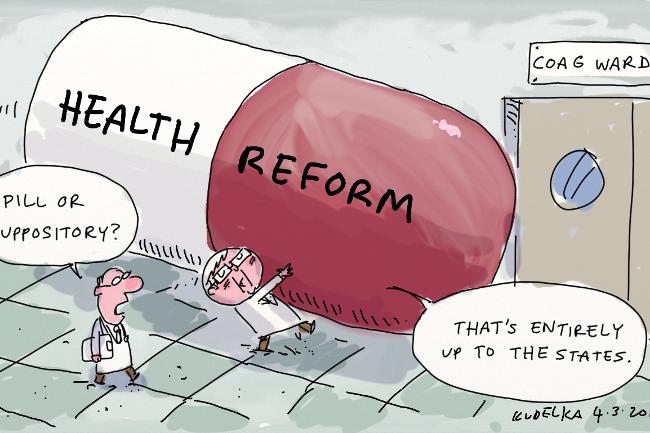
The National Health Reform Agreement (NHRA), signed by the Commonwealth Government and all states and territories in August 2011, committed to paying for public hospital expenditure, where practicable, using Activity-Based Funding (ABF), also known as Case mix or Episode-based funding.
ABF supports hospitals on the basis of the number, type and mix of patients treated. To ensure that payments are fair and equitable across public, private or not-for-profit providers of public hospital services, they are based on the same price for the same service.
Setting this price is the role of the Independent Hospital Pricing Authority (IHPA), established by the Commonwealth per Section B3 of the NHRA. Each year a National Efficient Price (NEP) is determined and used to calculate Commonwealth funding for public hospital services, and also to benchmark the efficient cost of providing those services.
The NEP is based on the average cost of an admitted acute episode of care provided in public
hospitals during a financial year. Each episode of patient care is allocated a National Weighted Activity Unit (NWAU). The episodes of acute care are coded using the Australian-Refined Diagnosis-Related Groups (AR-DRGs) classification system.
The NWAU is a measure of hospital activity expressed as a common unit. The ‘average’ hospital service is worth one NWAU. The price of each public hospital service is calculated by multiplying the NWAU allocated to that service by the NEP. The NEP for 2018-19 is $5,012 per NWAU.
The National Hospital Cost Data Collection (NHCDC) tabulates cost weights*, total number of separations, average length of stay and direct and indirect costs by AR-DRG. The most recent report available is for Round 20 (2015-16). The AIHW provides principal diagnosis AR-DRG data cubes up to, and including, 2016-17, although these do not include cost weights.
As diagnosis is a major driver of in-patient hospital costs, ABF for admitted acute care services is based on DRGs. Other hospital services: non-admitted out-patient care; admitted sub-acute & non-acute care; emergency department care; admitted mental health care; and teaching, training & research are costed using other information. Excel-based NWAU calculators are available for some of these service streams.
*Note: NHCDC Cost Weights and NWAU should be identical for the same service within the same time period.
Cartoon source: http://www.sauer-thompson.com/archives/opinion/health/ [14 July 2018]

